Professional & Trading
PTCB Anki Deck — 300 PTCE Flashcards + Free Practice Test
300 PTCE cards weighted to the 2026 outline — drugs, law, safety, sigs, and math — pairs with the 2026 printable study guide PDF.
One-time purchase · .apkg for Anki (desktop, AnkiMobile, AnkiDroid) · instant download via Gumroad
Not ready to buy? Take the free 25-question diagnostic →
57 people have purchased this deck. Recent UniPrep2Go checkout activity — not an official exam board figure.
Exam version & sources
Pharmacy Technician Certification Exam (PTCE)— what this product is (and isn't)
- Exam version
- January 6, 2026
- Official source
- CPhT / PTCE exam overview
- Last reviewed
- October 2, 2026
- What this covers
- 300 cards — 60 high-yield Top 200 drugs, interactions, DEA and DSCSA law, patient safety, sig codes, pharmacy math, and order entry
- Does not replace
- Independent study aid — it does not replace PTCB's official practice exam and your pharmacy technician training program.
Free practice test
Free PTCB Practice Test 2026 | 25Q Free, 90Q Timed
PTCB Pharmacy Technician knowledge diagnostic — 90-question timed check (free 25-question version) with topic scoring and a readiness report before you buy the deck. It checks what you know; it is not a copy of the official exam format.
Take the free 25-question diagnosticSample cards
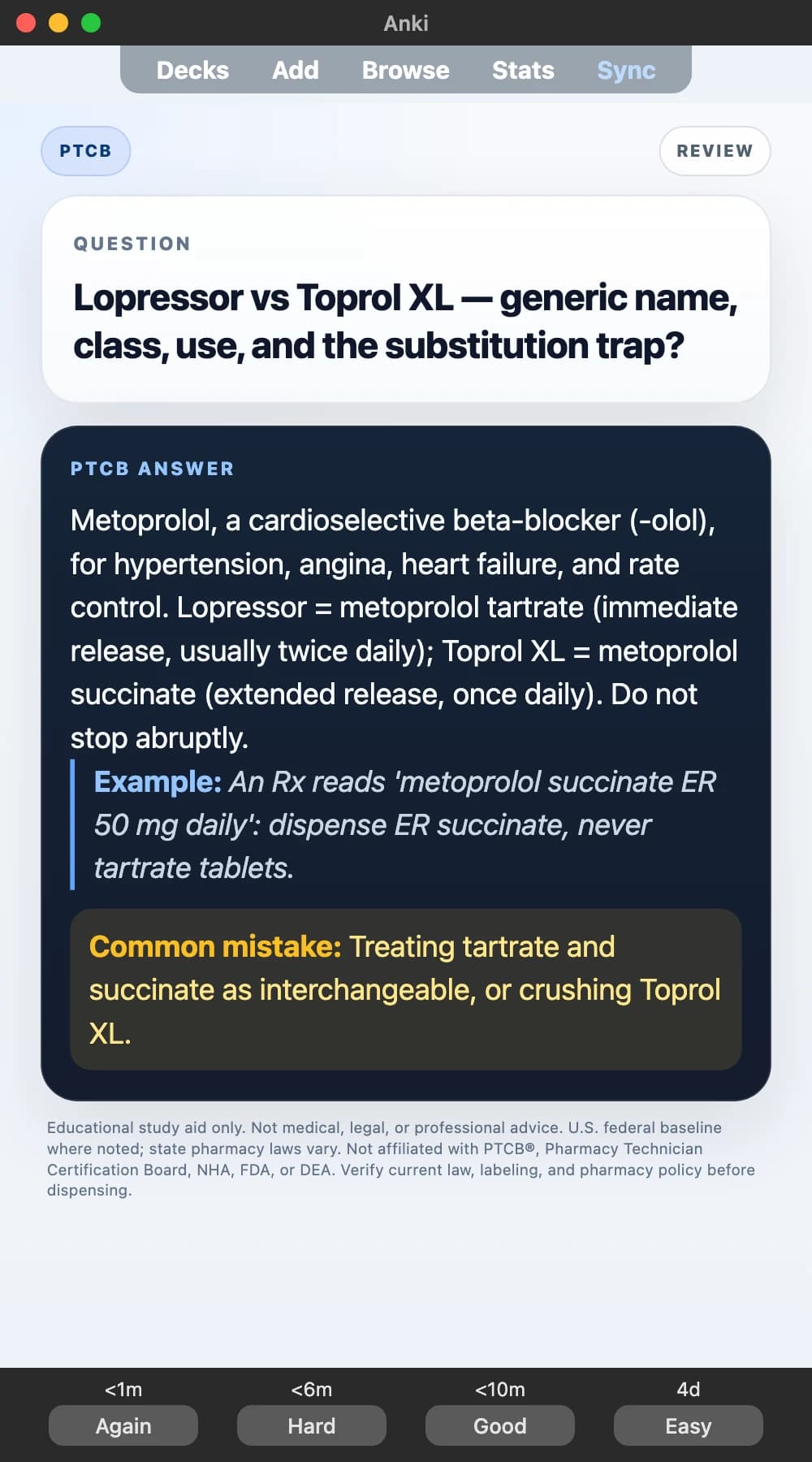
Lopressor vs Toprol XL — generic name, class, use, and the substitution trap?
Metoprolol, a cardioselective beta-blocker (-olol), for hypertension, angina, heart failure, and rate control. Lopressor = metoprolol tartrate (immediate release, usually twice daily); Toprol XL = metoprolol succinate (extended release, once daily). Do not stop abruptly.
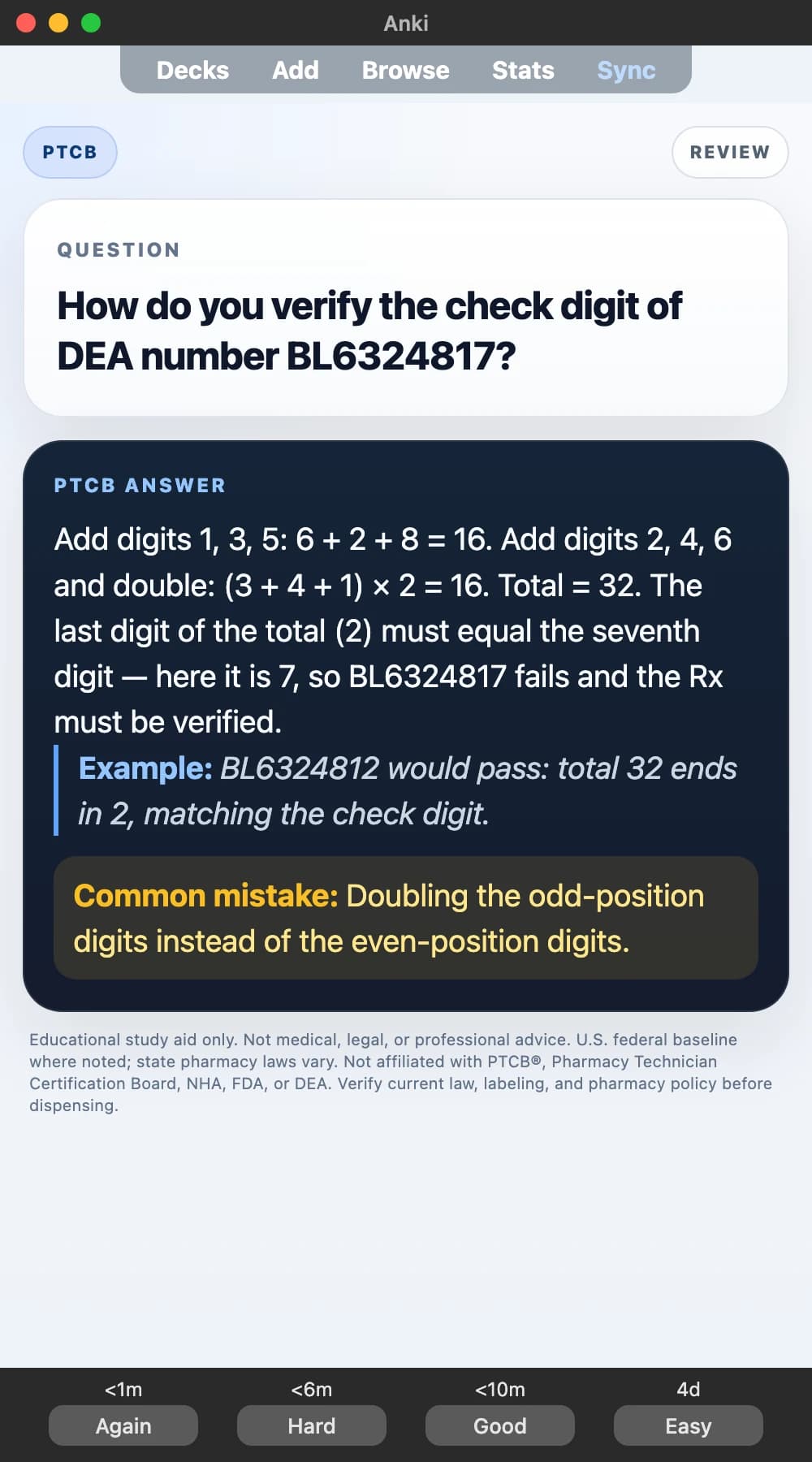
How do you verify the check digit of DEA number BL6324817?
Add digits 1, 3, 5: 6 + 2 + 8 = 16. Add digits 2, 4, 6 and double: (3 + 4 + 1) × 2 = 16. Total = 32. The last digit of the total (2) must equal the seventh digit — here it is 7, so BL6324817 fails and the Rx must be verified.
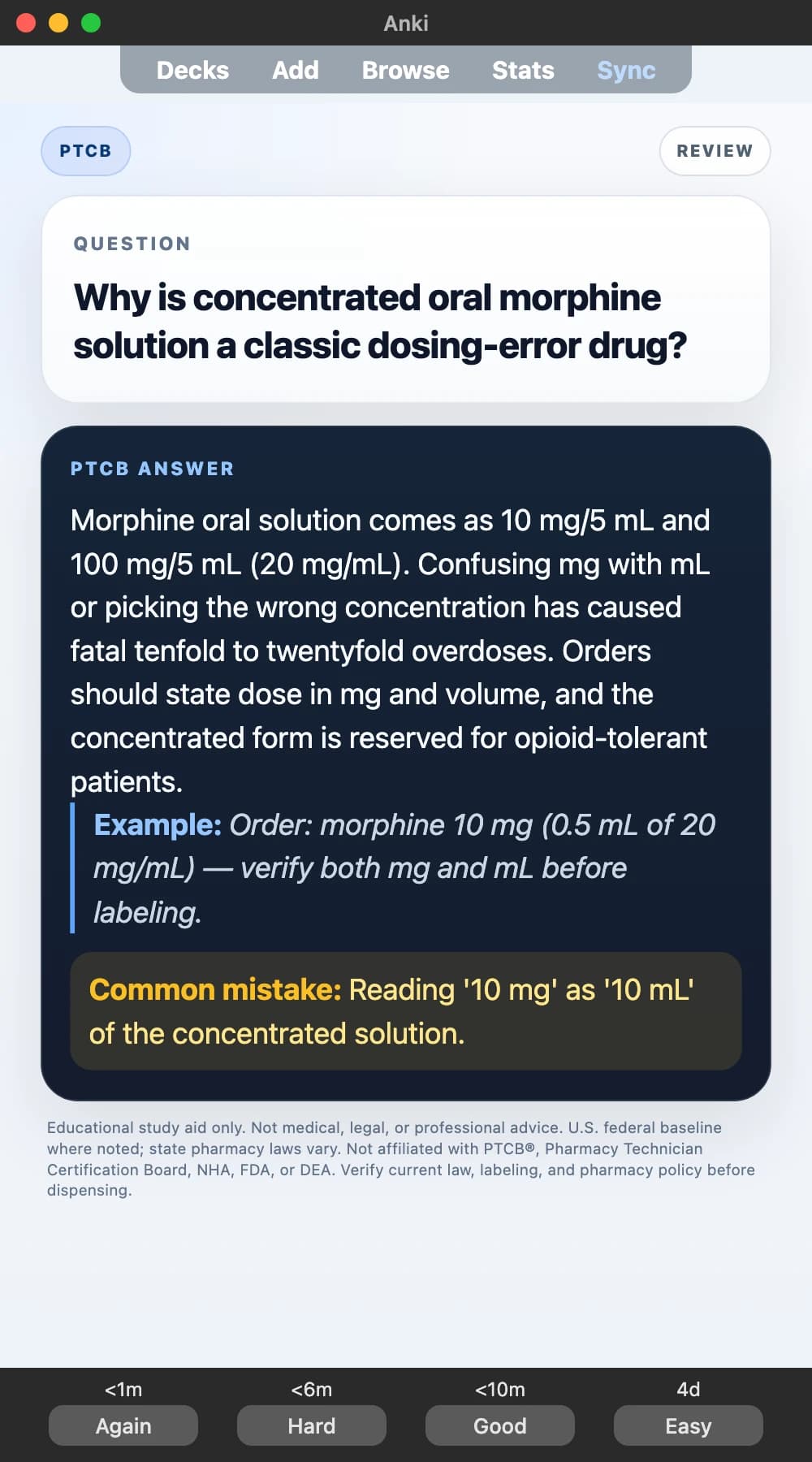
Why is concentrated oral morphine solution a classic dosing-error drug?
Morphine oral solution comes as 10 mg/5 mL and 100 mg/5 mL (20 mg/mL). Confusing mg with mL or picking the wrong concentration has caused fatal tenfold to twentyfold overdoses. Orders should state dose in mg and volume, and the concentrated form is reserved for opioid-tolerant patients.
Ready to drill with the full deck?
Instant .apkg download after Gumroad checkout.
Get 300-Card PTCB Pharmacy Technician Deck — $11 USDPairs with
PTCB Study Guide 2026
January 2026 PTCE outline/blueprint PDF — domain chapters, 80-question exam, cheat sheets; pairs with 90Q online mock (free 25-question version) + Anki.
Product facts
- Cards
- 300
- Coverage
- 60 high-yield Top 200 drugs, interactions, DEA and DSCSA law, patient safety, sig codes, pharmacy math, and order entry
- Format
- .apkg
- Price
- $11 USD
- Checkout
- Gumroad
- Exam cycle
- January 2026 PTCE / pharmacy technician review
- Delivery
- Digital download through Gumroad
Coverage by exam topic
| Topic | Exam weight | Cards |
|---|---|---|
| Medications | 35% | 105 cards: 60 high-yield drugs (generic, class, use, safety point), interactions, stems, dosage forms, storage |
| Patient Safety & QA | 23.75% | 71 cards: high-alert drugs, LASA pairs, ISMP abbreviations, error reporting, USP <797>/<800> |
| Order Entry & Processing | 22.5% | 68 cards: sig codes, days supply and dosing math, claims, inventory |
| Federal Requirements | 18.75% | 56 cards: DEA schedules and forms, C-II rules, DSCSA, HIPAA, REMS, recalls |
Exam facts
Pharmacy Technician Certification Exam (PTCE)
The PTCE (Pharmacy Technician Certification Exam) is the certification exam administered by the Pharmacy Technician Certification Board (PTCB) in the United States. This page gives exam structure, the 2026 content outline, high-yield facts, and independent UniPrep2Go study products (not official PTCB material).
- Questions
- 90 multiple-choice (80 scored + 10 unscored pretest)
- Time
- 1 hour 50 minutes exam time (~2 hours total with 5-minute tutorial and 5-minute post-exam survey)
- Passing score
- 1,400 scaled score
- Scoring
- 1,000–1,600 scaled score
- Delivery
- In-person at Pearson VUE test centers nationwide (PTCE online proctoring suspended December 12, 2025)
- Administered by
- Pharmacy Technician Certification Board (PTCB)
Knowledge domains and weights
| Domain | Official weight |
|---|---|
| Medications | 35.00% |
| Federal Requirements | 18.75% |
| Patient Safety and Quality Assurance | 23.75% |
| Order Entry and Processing | 22.50% |
What changed in the current exam cycle
- January 2026 outline weights: Medications 35%, Federal Requirements 18.75%, Patient Safety and Quality Assurance 23.75%, Order Entry and Processing 22.50% (PTCE Content Outline v1.4, August 2024).
- Federal Requirements increased from 12.5% and Medications decreased from 40% versus the pre-January 2026 PTCE content outline.
- Drug Supply Chain Security Act (DSCSA) traceability is listed under Federal Requirements (section 2.6) in the January 2026 outline.
- The January 2026 PTCE Content Outline does not include dedicated compounding or alligation knowledge areas.
High-yield facts (commonly tested)
- DEA Schedule II drugs: no refills permitted; a new prescription is required each time (e.g., oxycodone, amphetamines, methylphenidate).
- DEA Schedules III–IV: up to 5 refills within 6 months if authorized.
- The five rights of medication safety: right patient, drug, dose, route, time.
- High-alert medications include insulin, anticoagulants, opioids, and chemotherapy agents.
- Refrigerated vaccine storage range: 2–8 °C with documented daily minimum and maximum temperatures.
- Days supply = quantity dispensed ÷ doses per day.
- IV flow rate (mL/hr) = total volume ÷ infusion time in hours.
- Percent strength: % w/v = grams per 100 mL; % w/w = grams per 100 g.
- Weight conversion: 1 kg = 2.2 lb (divide pounds by 2.2 for kilograms).
- DSCSA requires traceability of prescription drugs through the supply chain.
Common Pharmacy Technician Certification Exam (PTCE) questions
Straight answers to the questions candidates usually search before buying prep or booking the exam.
What score do you need to pass the PTCE?
A scaled score of 1,400 on a 1,000–1,600 scale. Only 80 of the 90 questions are scored; 10 are unscored pretest items.
How many questions is the PTCE and how long is it?
90 multiple-choice questions in 1 hour 50 minutes of testing time.
What are the PTCE knowledge domains for 2026?
Medications (35%), Patient Safety and Quality Assurance (23.75%), Order Entry and Processing (22.5%), and Federal Requirements (18.75%).
Is compounding still on the PTCE?
The January 2026 PTCE Content Outline (effective January 6, 2026) does not include dedicated compounding or alligation knowledge areas.
How is days supply calculated on the PTCE?
Days supply = quantity dispensed ÷ doses per day.
Verify current exam fees, scheduling, and administrative details at ptcb.org/credentials/certification/certified-pharmacy-technician/. Independent study aid — not official exam material.
More about PTCB Pharmacy TechnicianStudy tips, positioning, and how this deck compares
PTCB / PTCE exam prep
Front-load high-yield drugs and interactions, high-alert safety, DEA schedules, DSCSA, and days-supply math — aligned to the January 2026 PTCE blueprint. Pair with the printable study guide for domain chapters and an 80-question practice exam; drill 10–15 cards per shift on your phone.
Built for: Pharmacy technician candidates, pharmacy tech students, career changers preparing for the PTCE, and technicians who want daily drug, law, safety, and math recall on their phone.
Covers: 60 high-yield Top 200 drugs, interactions, DEA and DSCSA law, patient safety, sig codes, pharmacy math, and order entry.
- Spaced-repetition flashcards
- 300 exam-focused flashcards
- Topic coverage table and samples on this page
- Linked 90-question practice test (free 25-question version)
How this deck compares
PTCE rewards drug names, sig codes, and math speed — not 2,000 low-yield cards. Three hundred validated prompts beat a mega-pack when you have 15 minutes between fills.
| Approach | Typical size | Tradeoffs |
|---|---|---|
| Free community decks | 1,000–3,000 |
|
| Budget mega-packs | 1,000+ |
|
| This deck | 300 exam-focused flashcards |
|
PTCB Pharmacy Technician study guide
What is inside
300 unique cards in January 2026 PTCE proportions: 105 Medications (60 high-yield Top 200 drugs — generic, class, use, and the safety point — plus interactions, stems, dosage forms, and storage), 56 Federal Requirements (DEA schedules and forms, C-II rules, DSCSA, HIPAA, REMS, recalls), 71 Patient Safety (high-alert drugs, look-alike names, ISMP abbreviations, USP <797>/<800>), and 68 Order Entry (sigs, days-supply and dosing math, claims, inventory). Every card carries a worked example and a common mistake. Official PTCE is **90 questions (80 scored + 10 pretest) / 1 hour 50 minutes / scaled pass 1,400** at Pearson VUE (in-person; online proctoring suspended December 12, 2025). Math cards use the short integer setups the exam favors — no alligation or compounding (removed from the 2026 outline).
Shift-friendly study plan with the study guide
**Start:** Take the [90-question PTCB mock (free 25-question version)](/mock-exams/ptcb-pharmacy-technician-mock) for domain-weighted baseline scores. **Weeks 4–3:** Read Medications and Federal Requirements chapters in the [PTCB Study Guide 2026](/decks/ptcb-study-guide-2026); 15 Anki cards per shift. **Week 2:** Take the guide's 80-question practice exam; drill missed domains in Anki only. **Final week:** Print cheat sheets from the guide; mixed Anki review — 10–15 cards per shift.
Pitfalls this deck targets
Technicians miss look-alike/sound-alike pairs, misread sig abbreviations, and forget schedule II storage rules. Cards repeat high-error pairs the 2026 blueprint emphasizes.
Pharmacy Technician Certification Exam (PTCE) & product FAQ
What score do you need to pass the PTCE?
A scaled score of 1,400 on a 1,000–1,600 scale. Only 80 of the 90 questions are scored; 10 are unscored pretest items.
How many questions is the PTCE and how long is it?
90 multiple-choice questions in 1 hour 50 minutes of testing time.
What are the PTCE knowledge domains for 2026?
Medications (35%), Patient Safety and Quality Assurance (23.75%), Order Entry and Processing (22.5%), and Federal Requirements (18.75%).
Is compounding still on the PTCE?
The January 2026 PTCE Content Outline (effective January 6, 2026) does not include dedicated compounding or alligation knowledge areas.
How is days supply calculated on the PTCE?
Days supply = quantity dispensed ÷ doses per day.
Is this official PTCB material?
No. This is an independent study aid and is not affiliated with, endorsed by, or sponsored by PTCB, the Pharmacy Technician Certification Board, NHA, FDA, or DEA.